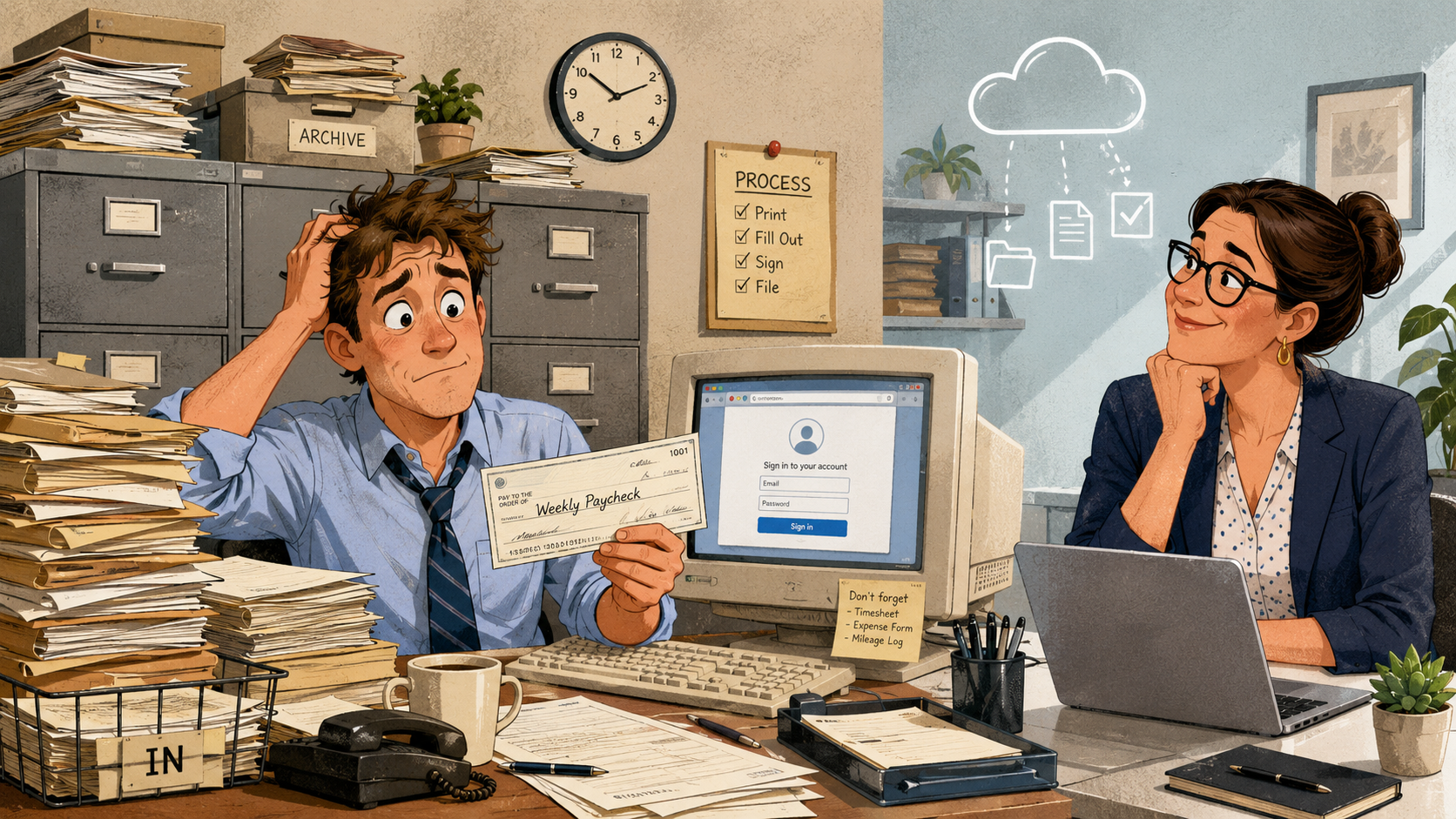
My son recently started a new job as a project manager.
Naturally, being his father—and someone who has spent 30 years working in a professional consulting environment—I was interested in hearing about the company, the projects, the people, and how they operate.
Then he casually mentioned something that stopped me in my tracks.
They still file hard copies of everything.
Not some things. Everything.
Apparently, somewhere out there, the filing cabinet is alive and well.
I immediately pictured rows of metal cabinets sitting proudly in an office somewhere, completely unaware that SharePoint, OneDrive, Teams, cloud storage, document management systems, and searchable electronic files have been invented.
But then came the part that really got me.
Their email system.
They aren’t using Microsoft 365 or another modern business email platform integrated with their computers and mobile devices. To check their email, employees apparently have to open a web browser, go to a website, log in, and retrieve their messages there.
I had questions. Many questions.
My first was whether the website made the familiar screeching sound of a dial-up modem when they logged in.
My second was whether incoming messages were delivered electronically or by someone riding through town on horseback.
Obviously, I’m exaggerating. A little.
But the conversation got me thinking about something that probably exists in far more companies than we realize.
Good Companies Can Still Have Old Processes
It’s easy to assume that every business has moved to Microsoft 365, electronic document management, shared workspaces, cloud storage, automated workflows, searchable files, and modern collaboration tools.
They haven’t.
There are still successful companies using processes that were developed years—or even decades—ago because those processes continue to work.
And there is a perfectly reasonable explanation for that: nobody stopped long enough to change them.
When you’re busy running projects, serving clients, managing employees, meeting deadlines, and keeping a business operating, modernizing the filing system probably doesn’t make the top of Tuesday morning’s priority list.
So another report gets printed. Another folder gets created. Another document gets placed into a filing cabinet.
And eventually someone asks, “Where’s the Smith project file?”
Suddenly three people are standing around a filing cabinet like archaeologists searching for an ancient civilization.
The Problem Isn’t Paper. It’s Efficiency.
There’s nothing inherently wrong with keeping certain paper records. Some documents should be retained physically. Some organizations have regulatory, contractual, or operational reasons for doing so.
The problem comes when paper becomes the primary operating system of the business.
A well-organized electronic environment can make everyday work dramatically easier. Documents can be centrally stored and searched. Employees can collaborate without emailing multiple versions of the same document back and forth. Project teams can access current information without wondering whether the document sitting on someone’s desk is actually the latest version.
Permissions can be controlled. Files can be backed up.
And perhaps most importantly, nobody has to remember whether the Johnson project was filed under Johnson, ABC Corporation, Project 24-117, or “that folder Steve had last Thursday.”
Sometimes You Need a New Perspective
As my son described some of this to me, I found myself saying:
“I could probably help them with that.”
And then I realized something. That’s actually a pretty good description of why I started Go Marvelous Professional Services.
Not every business needs a massive consulting engagement. Sometimes a company simply needs someone to look at an existing process and say, “There might be an easier way to do this.”
Maybe it’s organizing documents. Maybe it’s improving spreadsheets. Maybe it’s creating trackers. Maybe it’s standardizing reports and templates. Maybe it’s moving project information into a shared electronic workspace.
Maybe it’s improving document control so employees aren’t maintaining five versions of the same file with names like Report_Final.docx, Report_Final2.docx, Report_Final_REVISED.docx, Report_Final_REVISED_USE_THIS_ONE.docx, and, inevitably, Report_Final_REVISED_USE_THIS_ONE_v3_PETE.docx.
Anyone who has worked in an office long enough has seen that folder.
Modernization Doesn’t Have to Mean Reinventing the Company
There’s also a misconception that improving business processes requires implementing some enormous enterprise technology system.
It doesn’t.
Sometimes the biggest improvements are surprisingly simple: a better folder structure, a shared project workspace, a standardized template, a properly designed Excel tracker, a document naming convention, a central location for project information, or a modern email and collaboration environment.
Small improvements can eliminate hours of unnecessary searching, duplicating, printing, filing, emailing, and wondering where someone put something.
And unlike the filing cabinet, electronic files don’t require you to open four drawers before discovering someone filed the document in the fifth one.
There May Be More Filing Cabinets Out There Than I Thought
My son’s new job reminded me that businesses operate at very different stages of technology and process maturity.
Some are highly automated. Some are completely cloud-based. Some have sophisticated document management environments.
And apparently, somewhere out there, someone is still printing an email and putting it in a folder.
That isn’t necessarily a criticism. It’s an opportunity.
Because sometimes improving a business doesn’t require changing what the company does. It simply requires finding a better way to support the people who are already doing it.
And then my son mentioned one final detail.
He gets paid every week.
By paper check.
At that point, I stopped asking questions.
Some traditions apparently refuse to go quietly.
So if your filing cabinet currently knows more about your company’s projects than your computer does—and your payroll department is still keeping the check-printing industry alive—
it might be worth asking whether some of those processes have outlived their usefulness.